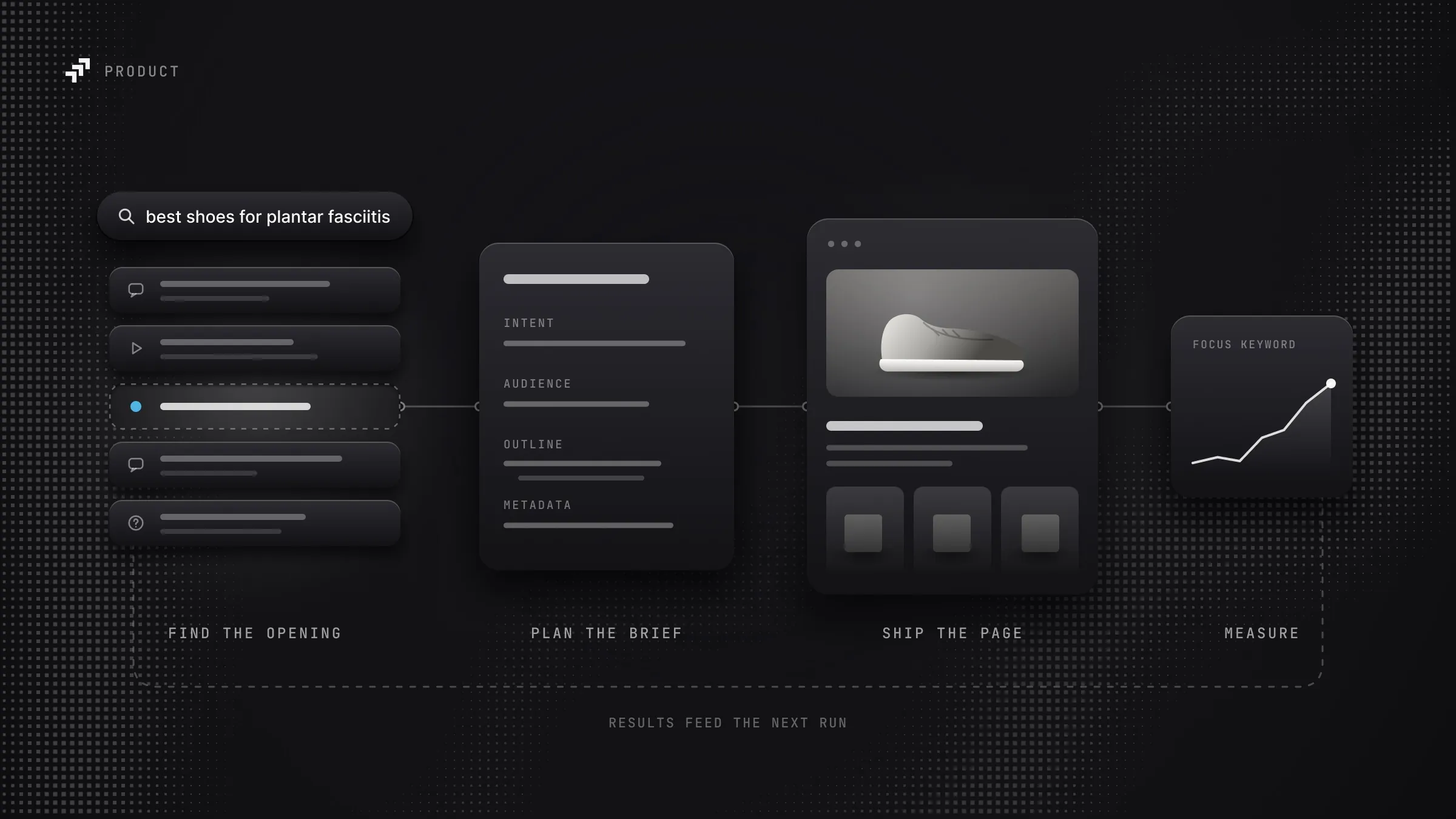
Take one footwear keyword family. The broadest query in it, "best shoes", is what the trade calls the head term. It draws 8,100 searches a month and scores 48 for difficulty. A more specific version of the same demand, "best shoes for plantar fasciitis", draws 27,100 at difficulty 22, three times the traffic for less than half the resistance. Those longer, more specific variants are the long tail, and its results page is held by forums rather than retailers. Openings like that exist in every catalog category. The constraint is how quickly a brand can turn one into a live page.
The content brief is what makes that conversion fast, and it is the most leveraged document in ecommerce marketing. A keyword tells you what to target; a brief tells you what to build. With one, the page's structure is a decision recorded before anyone writes, which is what lets the work move without a round of interpretation.
This post covers what a brief actually contains, what changes when you generate pages from structured outlines instead of raw prompts, and where the winnable openings are hiding in a category as picked-over as footwear. It's also a walkthrough of how Superpilot's SEO Agent does this work: sourcing the opportunity, planning the brief, and building the page from it.
What a Content Brief Actually Is
A content brief is the specification for a single page. Not a summary of an opportunity, not a paragraph of context. It is a set of decisions made before anyone writes, in a form precise enough to build from without a follow-up conversation.
The distinction that matters is precision. "Write something about running shoes for people with flat feet" leaves the intent, the outline, the audience, and the metadata open: four decisions that then get made in a thread, a meeting, or at review. A structured brief closes all four before anyone writes, which is the entire source of its speed advantage.
There's one more thing a good brief does, and it's easy to miss: it constrains what the page is not allowed to claim. The SEO Agent's brief maker is explicitly barred from planning sections that assert shipping terms, return windows, prices, discounts, guarantees, stock, or star ratings, because it has no verified data for any of them. A section titled "Free Shipping, Easy Returns, Shop With Confidence" is forbidden by the brief, not caught later in review. That's a compliance decision made at specification time rather than a copy-editing problem.
Worked Example: "Best Running Shoes for Flat Feet"
Here's where briefs earn their keep. Take "best running shoes for flat feet", 60,500 searches a month in the US. That single keyword can justify three completely different pages, and the brief is what decides which one you get.
Same keyword. The funnel stage decides the outline, the length, and the call to action.
Same query, three legitimate pages. The top-of-funnel version is an editorial guide for someone still learning what pronation means. The middle version compares options for someone weighing choices. The bottom version is a tight collection page for someone ready to buy.
Matching the stage to the query is what makes the page convert. Someone asking what arch support means is served by the editorial guide; someone ready to buy is served by the 700-word collection page with the call to action above the fold. Both are the correct page for their reader, and which one gets built is set by a single field, before any copy exists.
This is also why word count is an output, not a target. The bottom-of-funnel brief lands near 700 words because that is what the intent supports. The length follows the reader, not a house minimum.
Where the Openings Are in Footwear
Footwear is one of the most contested categories in ecommerce, which makes it a useful place to show the openings are real. The chart is sorted easiest-first, so the winnable pocket reads at the top, and our keyword sits in it.
Difficulty (bar) and monthly volume (label) across the footwear family. Green is the winnable pocket. Note that the easiest terms are not the smallest.
The three easiest terms are not the three smallest. "Best shoes for plantar fasciitis" draws 27,100 searches at difficulty 22; the head term "best shoes" draws 8,100 at difficulty 48, three times the demand for less than half the resistance. "Best running shoes for flat feet," the query we have been briefing, sits between them at 60,500 and difficulty 29.
So the intuition that shorter keywords are bigger and harder is only half right. They're harder, and frequently much smaller.
That's the shape. The more useful question is who currently holds those pages.
For "best running shoes for flat feet," the top ten includes a community forum, a social network, and a specialist discussion board alongside the review sites. For "best shoes for standing all day," the page is held by forums, video, and a Q&A site.
Composition is the signal the difficulty score omits. Count how much of each top ten is forum, video, or Q&A rather than a page selling something: the head term "best shoes" has 1 of 10, and every other query in the set has 2 to 5. Those results answer in scattered, anecdotal fragments, and none of them are being used to sell shoes, which is the gap a category page fills.
The incumbents are not weak. Several of those domains are far stronger than any single retailer. What is weak is the page type. A difficulty of 46 defended by forum threads is a softer target than a 29 defended by purpose-built category pages, and the score alone cannot tell you which one you are looking at. That is the difference between reading a number and reading the results page.
Those three situations are what the SEO Agent is built to distinguish, and its output isn't a metrics recap. It's an argument about who holds the page and why they're beatable. We've written before about how agents make page-generation decisions; the same principle applies upstream, at selection.
Why Outlines Beat Prompts
There's a shortcut available now that wasn't available three years ago: describe a page to a model and let it generate. It works, in the sense that a page comes out. But it fails in a specific, predictable way that's worth naming.
Generate from a prompt and the model chooses the structure, so two runs return two different outlines. Across fifty pages that yields fifty structures, and no shared internal-linking pattern to compound across them.
Generate from a brief and the structure is an input. The outline was decided against the search intent and the funnel stage before generation started. The model's job narrows from "invent a page" to "write these sections well." The variance that structure would have introduced is gone before generation starts, which is why two runs of the same brief produce the same page shape.
The compounding advantage is diagnostic. Because a brief records each decision (the intent read, the outline, the keyword choice), a page's result can be traced back to the specific call that produced it, and the next brief inherits that finding. Structure makes performance legible.
There's also a structural argument. Section headings are how search engines and AI answer engines parse a page into extractable claims, the same reason search guidance on creating helpful content emphasises clear organisation over sheer volume. An outline built deliberately against a query produces headings that map to how people actually ask, which is exactly the property that makes content citable. Our research on AI discoverability across retail brands found most brands invisible in AI responses for reasons that overlap heavily with why they're invisible in search: thin, unstructured category content. An outline fixes both at once.
From Brief to Live Page
A brief converts into traffic only once it is a page. Here is the same brief travelling both routes:
Both paths start with the same keyword and end with the same published page. The two removed steps consume only inputs the brief already records.
The two queued steps take intent, structure, audience, and metadata as inputs, all four already recorded in the brief, and emit the same specification in a different format. Their measurable contribution is elapsed time.
Removing them takes the path from five steps to three, and the count of people who must read the spec from three to one. The brief seeds the page build directly: the specification is the input, and the page returns structured and ready to review, with the outline it was specified with intact.
Two things worth stating plainly, because the alternative is overclaiming. A human still owns review: brand voice, product truth, merchandising judgement, legal. What's removed is the queue, not the editorial standard; our proofreading pass exists precisely because generated copy needs an on-brand check. And the page has to be genuinely good, which is why image selection runs against the brief rather than sitting as a manual step that would restore the queue the shorter path removed.
Then the loop closes. Because each page carries its focus keyword as a durable anchor, you can measure whether this page moved for this term: per-page attribution rather than an aggregate traffic line. Terms that convert reshape what the next sourcing run looks for; outlines that worked become the pattern for the next brief.
Putting It Together
The through-line: a keyword is a hypothesis, a brief is a specification, and a page is the test. Programs compound when they convert hypotheses into specifications at a steady rate.
What that looks like concretely, for one keyword family:
- Find the pocket. Head terms are smaller and harder than they look. One level down, on "for flat feet" or "for plantar fasciitis", demand often rises as difficulty falls.
- Read the results page. If forums, video, and Q&A hold the top ten, a structured category page is a better answer and the difficulty score is overstating the defense.
- Pick the funnel stage. This single decision sets the outline, the length, and the CTA, and it is the field that most determines whether the page converts.
- Write the brief as fields, not prose. Intent, audience, outline, links, metadata. Anything left implicit gets decided inconsistently downstream.
- Build from the outline, not from a prompt. Structure as input buys consistency across pages and a traceable result for each one.
- Measure the page against its focus keyword, then feed the result back into selection.
Fifty published pages outperform a five-hundred-keyword list for a reason that is arithmetic: a published page can rank and a row in a spreadsheet cannot. A shipped page also accrues signal from the day it goes live, and keeps accruing while the surrounding data moves: competitors publish, intent shifts, difficulty scores change. Publishing rate is the compounding variable.
That sequence is what the SEO Agent runs end to end: it sources the opportunity with a judgement about the results page, plans the brief against the funnel stage, builds the page from the outline, and anchors the measurement to the focus keyword so the next run is better informed than the last.