This year every commerce and marketing team on the planet received a mandate from their board: adopt AI into your workflow.
They also have existing explicit and implied mandates: 1) do not embarrass our company 2) adhere to this strict, many-page set of brand guidelines 3) our CEO reads every ad copy and website page with a fine-toothed comb and red pen.
Good luck!
I'm sure that the average marketing operator has opened up Claude/ChatGPT/Copilot (yes, brands use this!) and found that this is a hell of a challenge: sure, you can get the LLM to produce a bunch of text or images but… it's nowhere near good enough to publish onto your site (or other channel: email, ad, whatever). The AI gives you raw power, but lacks the context to be a true accelerant. This is a pain point being reported across industries — and "workslop" has become a worldwide challenge for employees and organizations.
At Superpilot we believe that this friction is not inevitable — you can have your AI cake and eat it too. We recently released a feature called Proof Reader that directly addresses this.
What Proof Reader Does
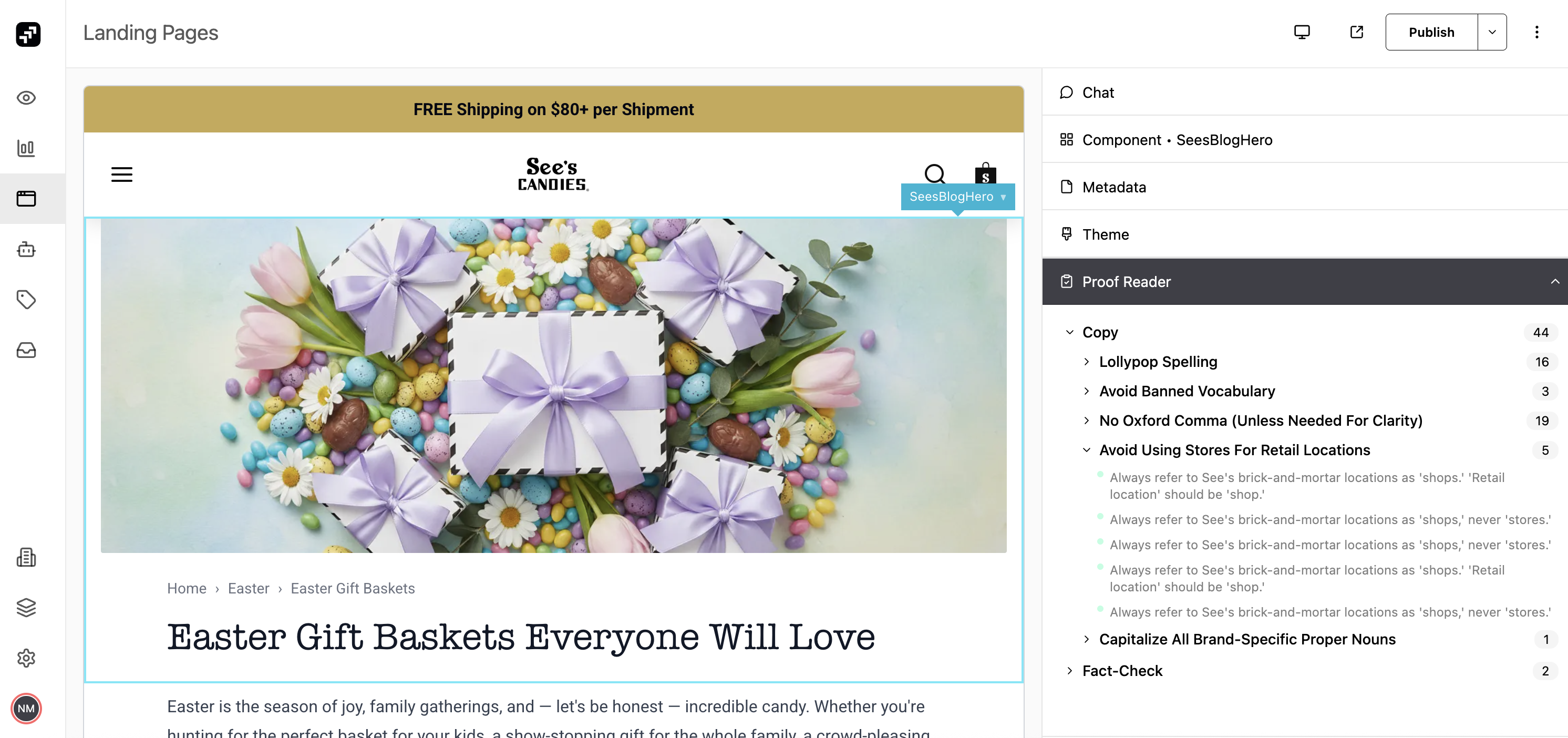
Proof Reader is an AI agent that runs as part of our page generation pipeline to ensure that the copy on pages is factually accurate, consistent with your site, and matches your brand's grammatical and stylistic conventions.
When the Superpilot app is generating page content, Proof Reader simultaneously runs to flag copy that may violate your brand guidelines. It proactively corrects any flagged language — the final page presented to you for review has already been reviewed and altered to conform to your specifications.
Two Categories of Rules
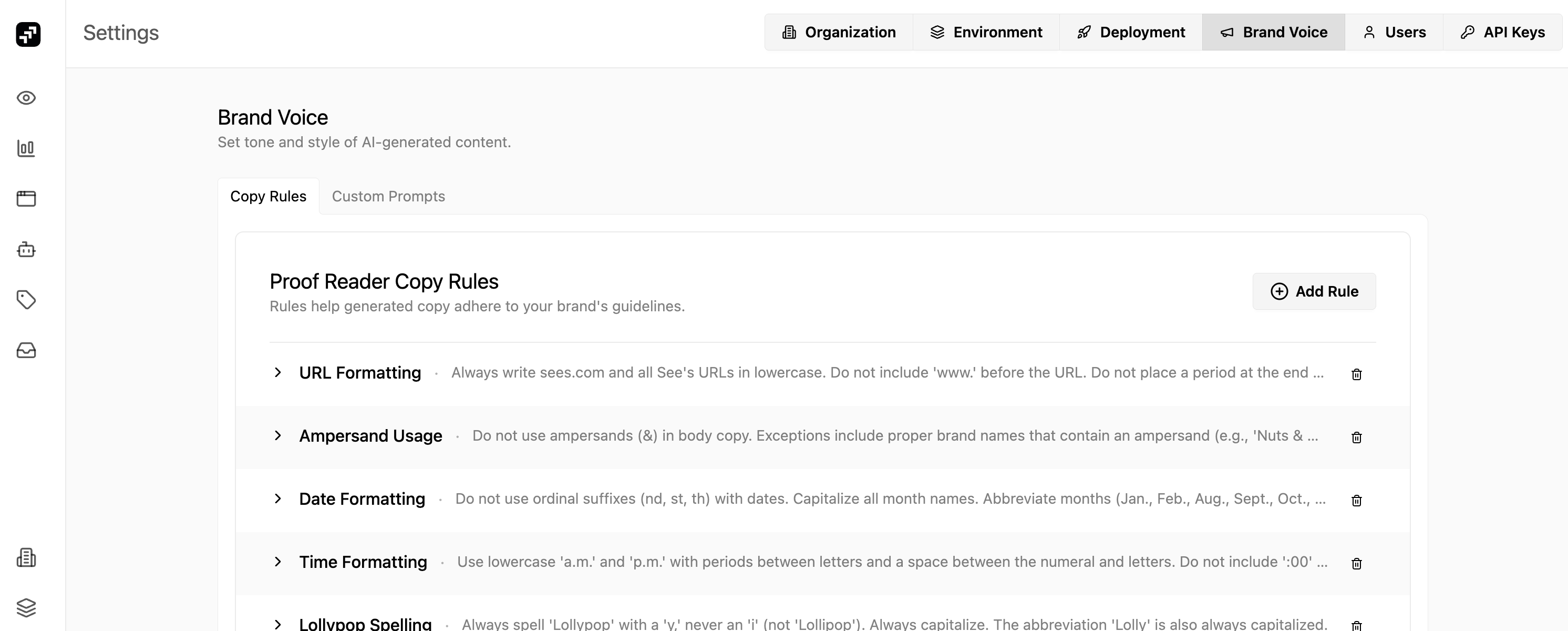
Proof Reader rules fall into two categories:
- Facts — We use integrated catalog metadata to ensure that claims made by the LLM are verifiably true. We also compare claims against your other site pages to ensure accuracy and consistency. For example: the product metadata notes that "steam kills 99.99% of bacteria," but the rest of the site says "99.9%." Proof Reader catches that.
- Copy — This category represents grammatical rules and stylistic tone that makes your brand, your brand. As an aside: I didn't realize ecommerce companies had such beef with the oxford comma until we started working on this feature…
Creating the Rules
Creating the rules themselves is easy: we can take any brand guidelines document (docs, PDFs, slideshows) and convert them into rules that will effectively influence the LLM in minutes.
Don't have formal written guidelines? No problem — we have a Superpilot Agent skill that will do deep research on your site, collect examples of different page types (content vs. PDP vs. landing page), and analyze elements within those page types to create distinct rules.
What was tricky
Using an LLM to correct an LLM may seem perilous but it's actually the inherent flexibility of an LLM that makes this system possible. At the same time we also needed a way of ensuring that the LLM's response always conformed to a set of non-negotiable requirements, such as adherence to a response schema while keeping the token costs of failure resolution in check.
With some clever (if we don't say so ourselves) engineering we were able to arrive at a system that's not only capable of reliably hunting out discrepancies, but one that is also generalized enough to support a diverse range of brand-specific requirements. If there's something that you care about with the copy that is used to represent your brand, then it's something that our Proof Reader can ensure is always enforced!
The Outcome
Our initial customer feedback: Proof Reader reduces editing time by approximately 1 hour for a 2,000-word page. In the real world, since most marketers need to pass draft assets around internally to copywriters, that can save 2-3 days of wait time to get content to market.
That's 2-3 days your content is live and earning visibility while your competitor is still in a Google Doc arguing about the oxford comma.