The Superpilot team has run AEO (AI Discoverability) reports for roughly two dozen of the world's largest retail and eCommerce sites. I want to share some aggregate findings that are revealing.
One point on our methodology: we run these tests in volume against most popular LLM APIs to control for things like user data and location influencing results.
📈 Visibility Is Shockingly Low
Product and category visibility for brands across all LLMs is a shockingly low average of 27%.
You can't buy ads in LLMs (yet) and the only way to influence this will be by getting meaningful, well-structured content into the LLMs as soon as possible. Given the low average, there is a huge first-mover advantage to be gained.
👟 Category Competition Varies Widely
Unsurprisingly, some categories are more difficult to gain mentions in than others—with footwear having the lowest mention rate at 17.8%.
This is probably a function of competition in this category, as it also has the highest mention of competitors to the target brand (7.8 competitors mentioned per intent query).
🌟 LLMs Are (Misleadingly) Positive
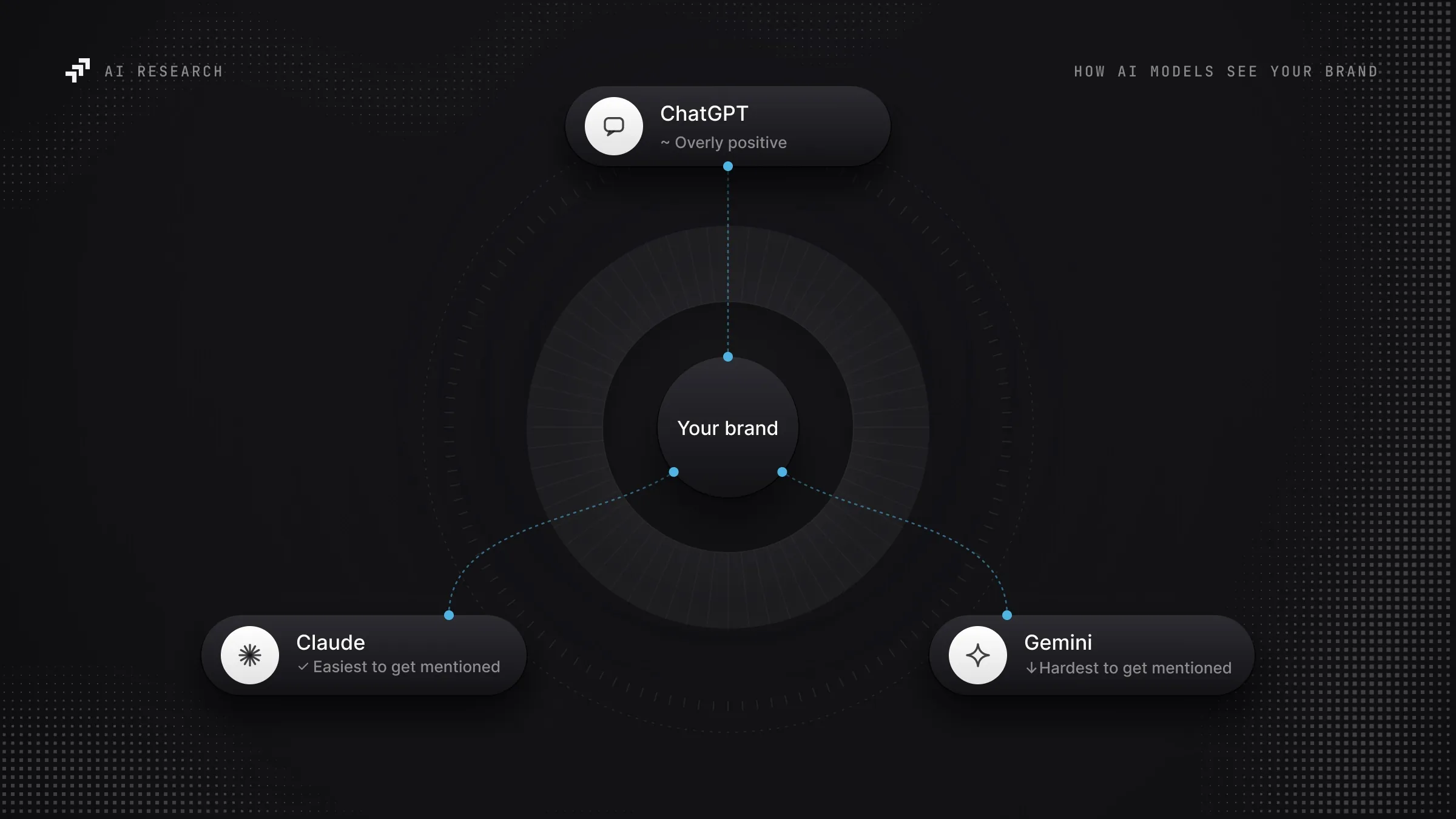
LLMs are consistently—perhaps misleadingly—positive about brands, which is a function of how they are trained.
One potentially damaging result we've seen is misinformation about product availability—something human shoppers won't be forgiving about.
If you want to get a real look at your brand's positioning, you need to explicitly ask for the relative strengths and weaknesses of your offering and products. Chart content or listicle-ready recent customer reviews really help.
🔎 Mention Rates Differ by LLM
Mention rate is not consistent across LLMs. For the brands we tested:
- Claude seems to be the easiest to gain mention and position in
- Gemini is the hardest
Unpacking why is a challenge, but it reveals that savvy operators need to assess these independently and experiment with different content strategies.