


The Opportunity
Claiming New Ground in the UK
Laurastar has been a Swiss family business for more than forty years. Their steam systems — generators, active boards, purifiers — are a considered purchase: the kind customers research carefully, compare closely, and ask a lot of questions about before they invest.
Laurastar has the answers to all of them. Four decades of engineering knowledge, a magazine, and a hygiene education hub built up over years.
The opportunity was to bring that expertise forward into the moment of decision. Ask an AI assistant what accessories professional laundries use, or how to get a shirt genuinely crease-free, or whether steam really kills dust mites in a mattress, and it assembles an answer out of whatever it can reach: a retailer's product listing, a forum thread, somebody's review round-up.
On questions Laurastar has spent forty years answering, Laurastar should be the one it finds first.
The route was quality content across an entire category — not one page for one keyword, but the whole neighborhood of questions a buyer asks on either side of the purchase. Do that well and visibility follows, in the UK market and anywhere else Laurastar sells.
The Execution
The Whole Category, Not One Page at a Time
Laurastar's team attacked this problem by building out the category in two deliberate clusters.
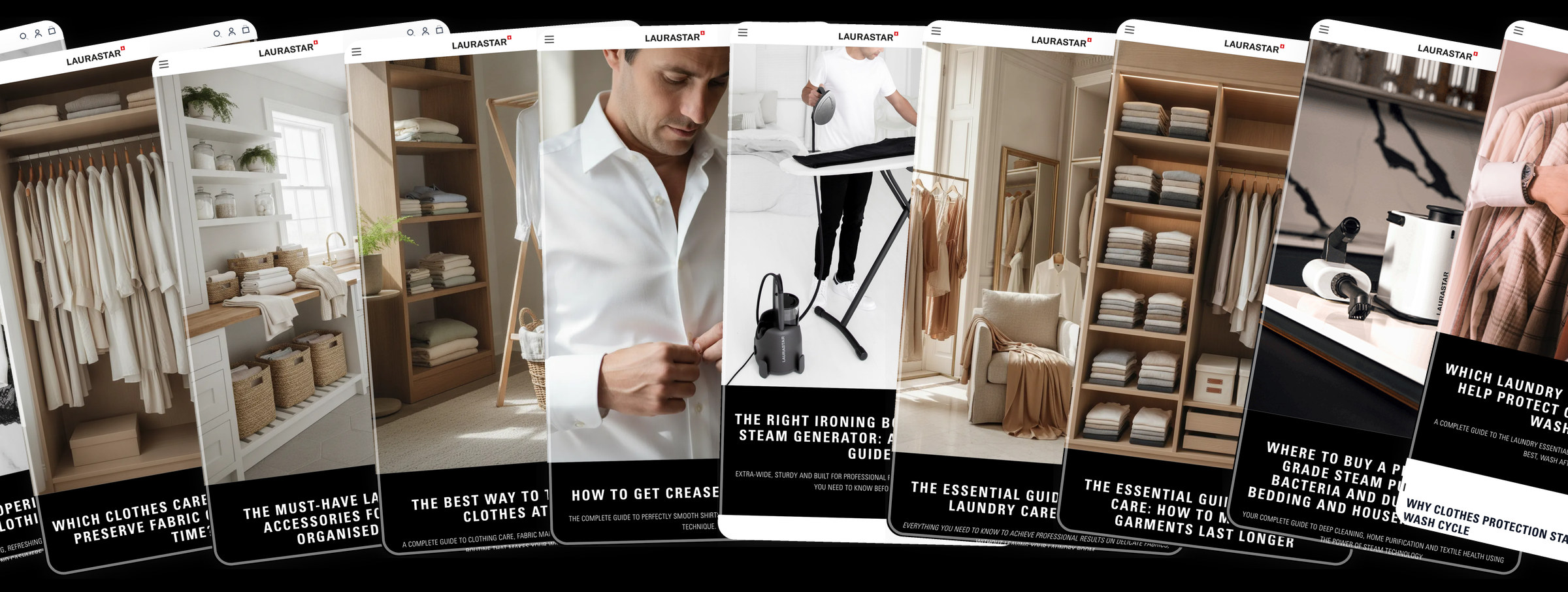
The first took on the appliance itself — eleven pages covering steam generators, ironing boards, active boards with vacuum and blower, garment care systems for silk and wool, and how to care for delicate fabrics.
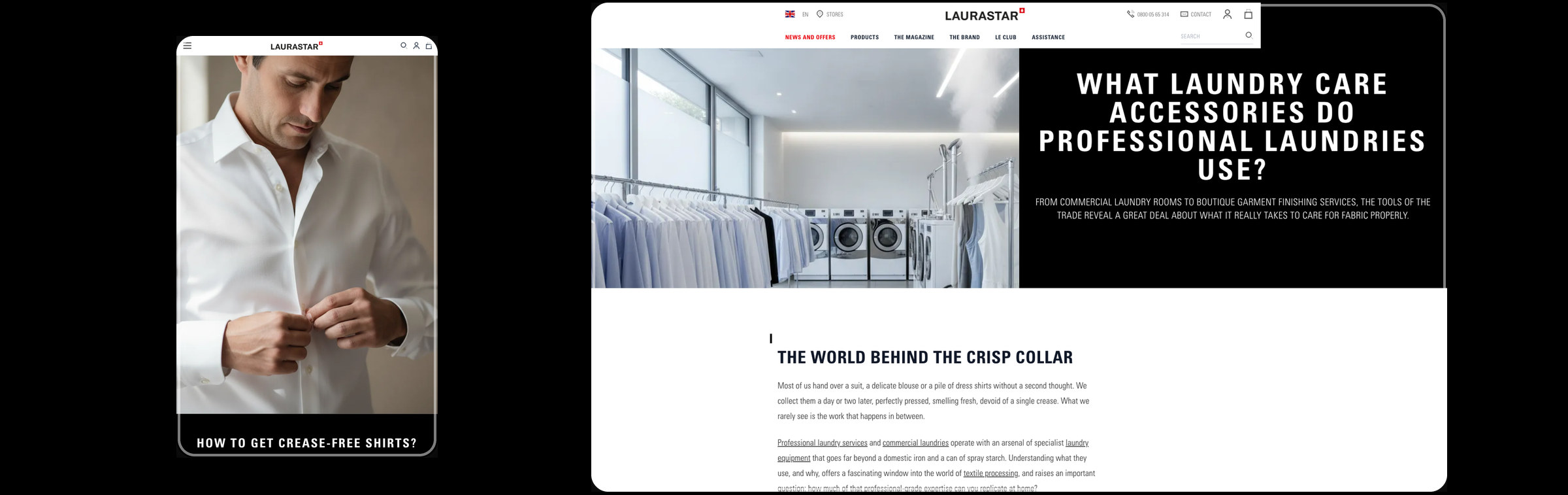
The second went after everything around it — nine pages on laundry accessories, protective soleplates, garment bags, steam purifiers, allergen and dust-mite removal, crease-free shirt technique, and what professional laundries actually use.
That is twenty pages in three weeks, each running to around 3,500 words and assembled from components generated against Laurastar's own design system, so that a cluster page reads as a native part of laurastar.co.uk and not as something bolted on. The product galleries draw directly from the live catalog, with nearly 150 product links across the second cluster alone.
That last part matters more than it sounds. The moment a page feels like a detour — different type, different furniture, a microsite parked at the edge of the domain — the trust a brand spent forty years building goes with it. The path from question to product never leaves Laurastar.
"Before, a page like this meant briefing an agency and waiting weeks to see a first draft. Now I can build a quality landing page in an afternoon and it comes back on-brand, with the right products already linked. I spend my time reviewing instead of chasing."
This was possible because Superpilot's agents are grounded in real business data — matching brand voice, pulling live products from the catalog, and following AEO best practices. The agent does the heavy lifting. The team stays in control: nothing goes live that the brand hasn't approved.
Why It Worked
The More Superpilot Learns, the Faster Laurastar Moves
Laurastar published the two clusters three weeks apart — and the team worked in a completely different way the second time.
Manual intervention fell away. The first cluster took six rounds of human revision per page and twelve days from first draft to live. The second took two rounds and four days. Copywriter agent runs dropped 42% month over month while output held steady, and a sprawl of four competing drafts per topic became one clean page each.
The nine pages of the second cluster went live in a single release, in under two seconds — because Superpilot had spent the first cluster learning Laurastar's voice, catalog and design language, and carried all of it into the second.
There is a lesson here that goes well beyond garment care. General-purpose LLMs are not built to learn your brand. They have never seen your catalog, your voice or your components, and they will not remember them tomorrow — which is why so much AI content reads as slop, and why the team ends up rewriting it anyway.
An AI tool for marketing has to do two things a general-purpose model cannot: ground itself in your context, and get better at your business the longer you use it. Superpilot accumulates both — brand rules, design patterns, product data and proof-reading standards compound run over run.
Laurastar's numbers are what that compounding looks like: the same people, the same tooling, and roughly 70% faster execution.
The team didn't get bigger. The work got easier.
"The second cluster took a third of the time of the first. I can see exactly what's going live, approve it, and publish the whole set in one go. We're covering ground in the UK we couldn't have covered at our old pace."
The Takeaway
What Best-in-Class Teams Do Differently
The teams pulling ahead are not simply using AI. They are using agents grounded in their own business — live catalog, brand voice, design system, and the SEO coverage a category demands — so that one agent does the traditional work of keyword research, briefing, copywriting, design and product linking at roughly three times the pace. That distinction is the whole difference between output you have to rewrite and output you can publish.
Use AI Adapted to Your Business
Off-the-shelf tools produce plausible copy from a blank page. An AI adapted to your vertical works from your real catalog, your brand voice and your own components — so pages arrive publishable, not merely readable.
Cover the Question Space from Multiple Angles
The win is not one page for one keyword. It is every adjacent question answered consistently, from every angle a buyer might come at it, so there is somewhere to land wherever they are in the journey.
Let the First Cluster Teach You and the Agent
A quality tool improves with use. The first cluster is where both sides calibrate — your team learns what to ask for, the agent learns your brand — and every cluster after it moves faster.
